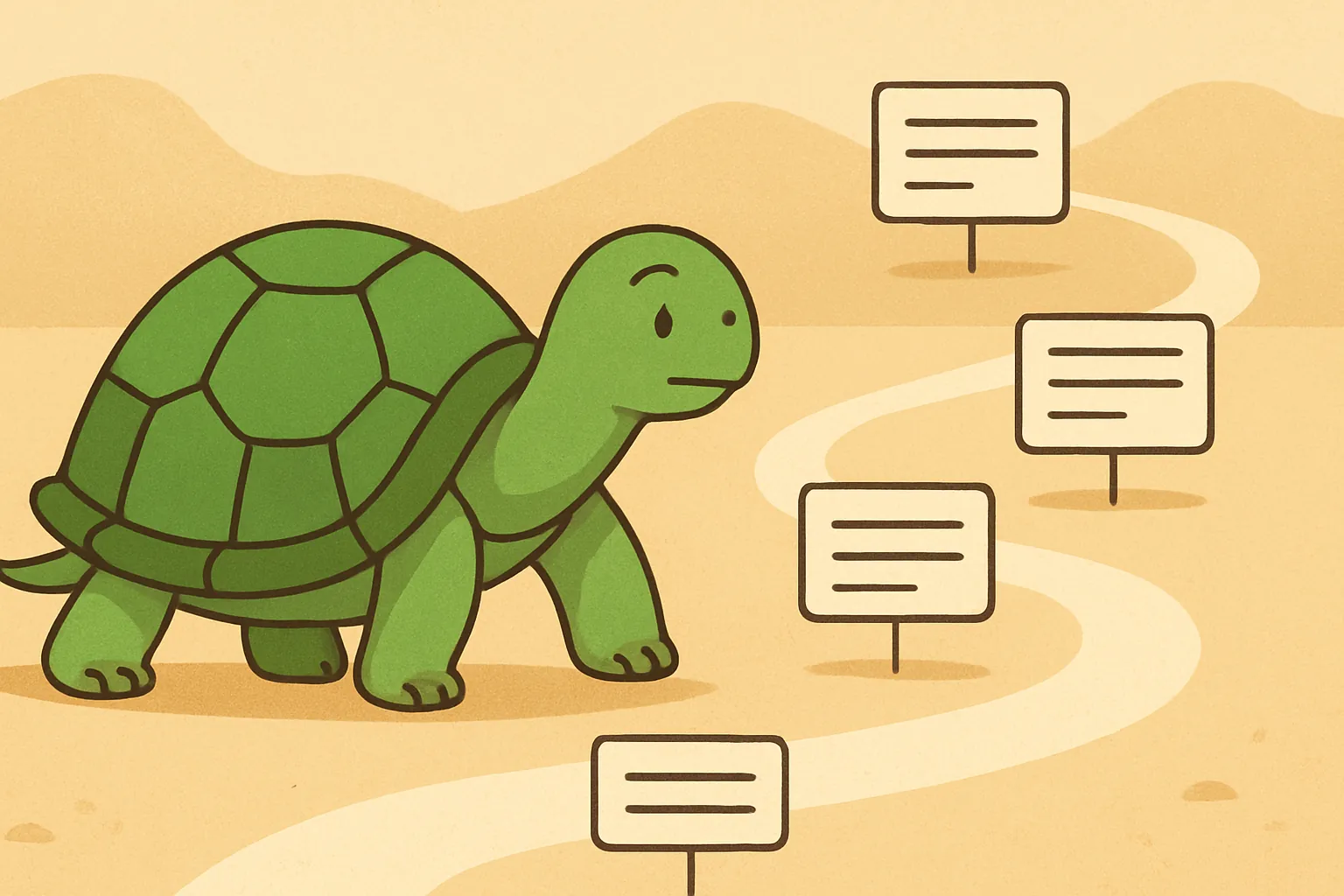
Language Learning Plateau: Why You Feel Stuck and How to Push Through
What Exactly Is a Language Learning Plateau?
Richards (2008, “Moving Beyond the Plateau: From Intermediate to Advanced Levels in Language Learning,” Cambridge University Press) described this phenomenon as a predictable stage in second language acquisition. He noted that learners at intermediate levels often develop a functional but limited version of the language. They can communicate, but they lack precision, range, and naturalness.
The plateau is not a sign of failure. It is, in fact, a predictable stage of development. Understanding this distinction matters. Many learners abandon their studies at precisely the point where the most rewarding progress lies ahead.
The B1-B2 Trap: Why Intermediate Is the Danger Zone
The plateau hits hardest between the B1 and B2 levels of the Common European Framework of Reference (CEFR). At B1, learners can handle routine situations. They order food, give directions, and discuss familiar topics. At B2, learners can engage with abstract ideas, follow complex arguments, and express themselves with reasonable fluency.
The gap between these two levels is deceptively large. Here is why.
Vocabulary Growth Slows Down
At the beginner stage, every new word is useful. You learn “water,” “eat,” “go,” and immediately apply them. At the intermediate stage, however, new words become less frequent in daily conversation. You already know the 2,000 most common words, which cover roughly 80% of everyday speech (Nation, 2001, Learning Vocabulary in Another Language, Cambridge University Press). Each additional word adds a smaller marginal gain.
Consequently, it feels like you are learning just as hard but gaining less. This is mathematically accurate, and it is also completely normal.
Grammar Becomes Fossilized
Selinker (1972, “Interlanguage,” International Review of Applied Linguistics) introduced the concept of fossilization. This occurs when certain errors become permanent habits. At intermediate levels, learners develop a “good enough” grammar that communicates meaning but contains consistent mistakes.
Because communication succeeds despite these errors, the brain has little motivation to correct them. The errors fossilize. Breaking these patterns requires deliberate, targeted practice rather than general exposure.
What Skill Acquisition Theory Tells Us
Robert DeKeyser’s work on skill acquisition theory offers a useful framework for understanding the plateau. DeKeyser (2007, Practice in a Second Language: Perspectives from Applied Linguistics and Cognitive Psychology, Cambridge University Press) argued that language learning follows the same pattern as other complex skills.
Three Stages of Skill Development
According to this framework, skill acquisition proceeds through three stages:
- Declarative stage: You learn a rule explicitly. For example, you memorize that past tense verbs in English often add “-ed.”
- Procedural stage: Through practice, you begin applying the rule without conscious thought. You start saying “walked” and “talked” without pausing to think about the rule.
- Automatic stage: The skill becomes fully automatic. You use past tense correctly without any awareness of doing so.
The plateau typically occurs during the transition from the procedural to the automatic stage. You know the rules. You can apply them with effort. However, making them fully automatic requires extensive, deliberate practice.
The Role of Deliberate Practice
DeKeyser emphasized that not all practice is equal. Mindless repetition does little. Instead, learners need what Ericsson, Krampe, and Tesch-Romer (1993, “The Role of Deliberate Practice in the Acquisition of Expert Performance,” Psychological Review) called deliberate practice: focused effort on specific weaknesses, with immediate feedback and conscious correction.
For language learners, this means identifying precise areas of weakness and targeting them. If your problem is conditional sentences, then you need concentrated practice on conditionals, not general conversation practice.

Six Strategies to Break Through the Plateau
1. Shift to Extensive Reading
Extensive reading means reading large quantities of text at or slightly below your current level. This approach builds vocabulary, reinforces grammar patterns, and develops reading fluency simultaneously.
Krashen (2004, The Power of Reading, Libraries Unlimited) compiled decades of research showing that extensive reading produces gains in vocabulary, grammar, spelling, and writing ability. For plateau learners, extensive reading provides the massive input needed to push implicit knowledge from procedural to automatic.
Choose materials you genuinely enjoy. If you like mysteries, read mysteries. If you prefer science articles, read those. The key is volume. Aim for at least 30 minutes of pleasure reading per day. TortoLingua offers graded reading content that helps learners find texts matched to their current level, which can be especially useful during this transitional period.
2. Notice and Record New Patterns
Schmidt’s Noticing Hypothesis (1990, “The Role of Consciousness in Second Language Learning,” Applied Linguistics) proposed that learners must consciously notice new language features before they can acquire them. At intermediate levels, this becomes harder because most input feels comprehensible. You understand the meaning but miss the specific structures used to convey it.
Therefore, keep a language notebook. When you encounter an interesting phrase, a new use of a familiar word, or a grammatical structure you would not have produced yourself, write it down. Review your notes regularly. This active noticing bridges the gap between passive understanding and active production.
3. Increase Output Complexity
Swain’s Output Hypothesis (1985, “Communicative Competence: Some Roles of Comprehensible Input and Comprehensible Output in Its Development”) argued that producing language forces learners to process it more deeply than merely understanding it. When you speak or write, you must make precise grammatical choices that comprehension does not require.
Push yourself to write longer texts: journal entries, essays, forum posts, or stories. In speaking, try explaining complex topics rather than relying on simple exchanges. This productive pressure reveals gaps in your knowledge and creates opportunities for growth.
4. Use Shadowing for Fluency
Shadowing involves listening to native speech and repeating it simultaneously, following just a second behind the speaker. This technique, studied by Hamada (2016, “Shadowing: Who Benefits and How?,” Uncovering EFL Learners’ Productive Knowledge), improves pronunciation, prosody, and processing speed.
For plateau learners, shadowing is particularly valuable because it targets automaticity. You practice producing language at natural speed without time to consciously apply rules. Start with short segments and gradually increase length as you become more comfortable.
5. Study Collocations and Chunks
Advanced speakers do not construct sentences word by word. Instead, they use prefabricated chunks and collocations: word combinations that naturally occur together. Pawley and Syder (1983, “Two Puzzles for Linguistic Theory: Nativelike Selection and Nativelike Fluency”) argued that fluency depends on knowing thousands of these formulaic sequences.
At the plateau stage, shifting focus from individual words to chunks produces rapid gains. Instead of learning “make” and “decision” separately, learn “make a decision” as a unit. Instead of learning “heavy” as an adjective, learn “heavy rain,” “heavy traffic,” and “heavy accent” as collocations.
6. Get Specific Feedback
General conversation practice maintains your current level but rarely pushes you beyond it. To grow, you need feedback that targets your specific errors. A tutor, language exchange partner, or writing correction tool can provide this.
Long’s Interaction Hypothesis (1996, “The Role of the Linguistic Environment in Second Language Acquisition”) demonstrated that negotiation of meaning during interaction drives acquisition. When a conversation partner signals that they do not understand, or corrects your output, your brain is forced to restructure its internal grammar. Seek out these corrective interactions deliberately.
Measuring Progress Differently
Part of the plateau problem is measurement. At beginner levels, progress is obvious. You go from zero to ordering coffee. At intermediate levels, progress happens in subtler ways. You need different metrics to see it.
Track Comprehension Speed
Instead of measuring what you understand, measure how quickly you understand it. Can you follow a podcast without pausing? Can you read a news article without looking up words? Speed improvements are real progress, even when your “level” label stays the same.
Monitor Error Reduction
Record yourself speaking at regular intervals. Over weeks and months, you will notice that certain errors decrease in frequency. This is the procedural-to-automatic transition in action. You may not feel fluent, but objective comparison reveals genuine improvement.
Expand Topic Range
Track the topics you can discuss comfortably. If three months ago you could talk about food and travel, and now you can also discuss politics and technology, that represents meaningful growth. Vocabulary breadth across domains is a reliable indicator of advancing proficiency.
Count Vocabulary Depth
Rather than counting total words known, assess how deeply you know them. Do you know multiple meanings of common words? Can you use them in different contexts? Do you know their collocations? Depth of vocabulary knowledge is what separates intermediate from advanced learners (Read, 2000, Assessing Vocabulary, Cambridge University Press).
The Plateau Is a Bridge, Not a Wall
Hitting a plateau does not mean you have reached your limit. It means you have exhausted the strategies that worked at lower levels. The fast, visible gains of early learning naturally give way to slower, deeper growth at intermediate stages.
The research is clear on this point. Learners who adjust their strategies, increase their input volume, and target specific weaknesses consistently break through to advanced levels. Those who continue doing what worked at lower levels stay stuck.
Shift your approach. Read extensively. Practice deliberately. Notice patterns. Produce complex output. Measure differently. The plateau is temporary. The skills you are building, however, are permanent.